1Lesson
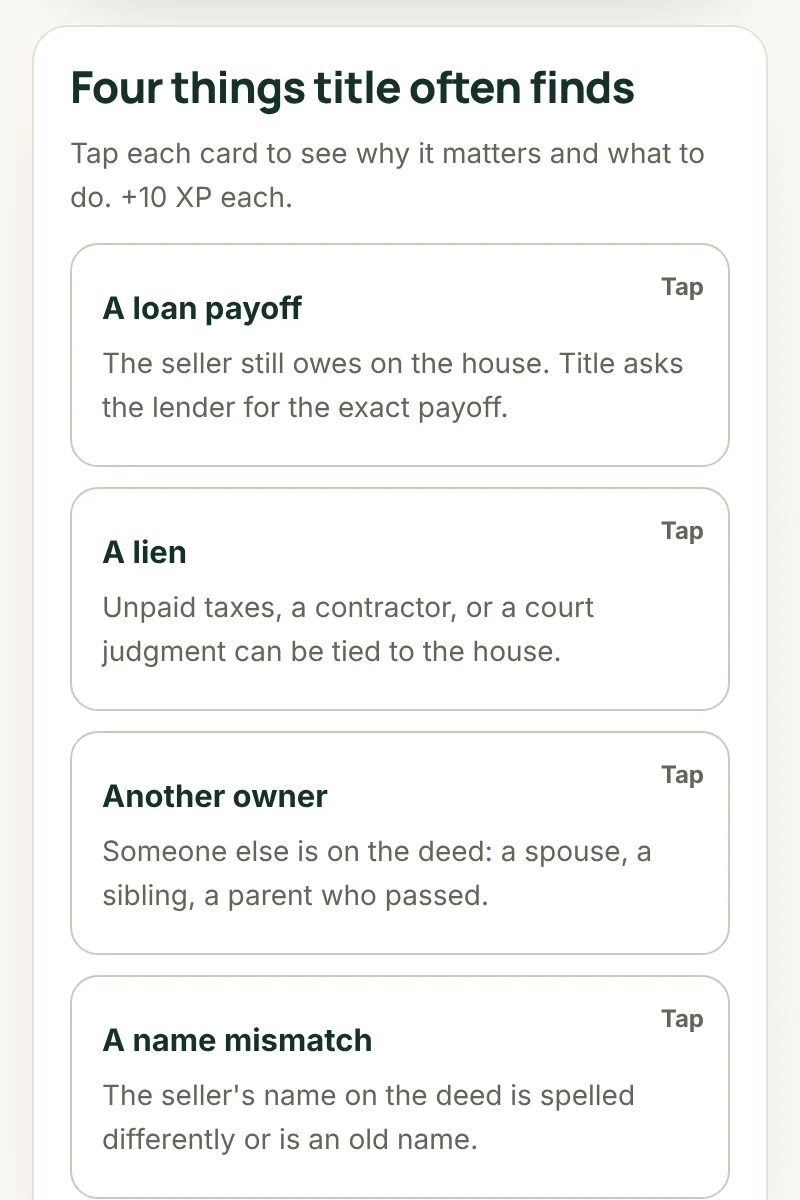
Flip cards teach the few things the level is about. Quick checks between the cards make sure each idea stuck before the games start.
Your team
Practice paths for every seat on a home-buying team, and free tools for the deal on the desk. They come with every Climbmark plan, next to the numbers from your CRM.
A week on the team
This is the week the app suggests to a team lead. It takes two short huddles and a few minutes of each rep's own time, and it ends with the business owner reading one report.
Inside a level
Its rounds come in the same order on every path. Each round below is pictured from a different job. The rounds are named for the job: an acquisitions rep gets practice visits and a boss visit, and a team lead gets coaching talks and a boss talk.
Flip cards teach the few things the level is about. Quick checks between the cards make sure each idea stuck before the games start.
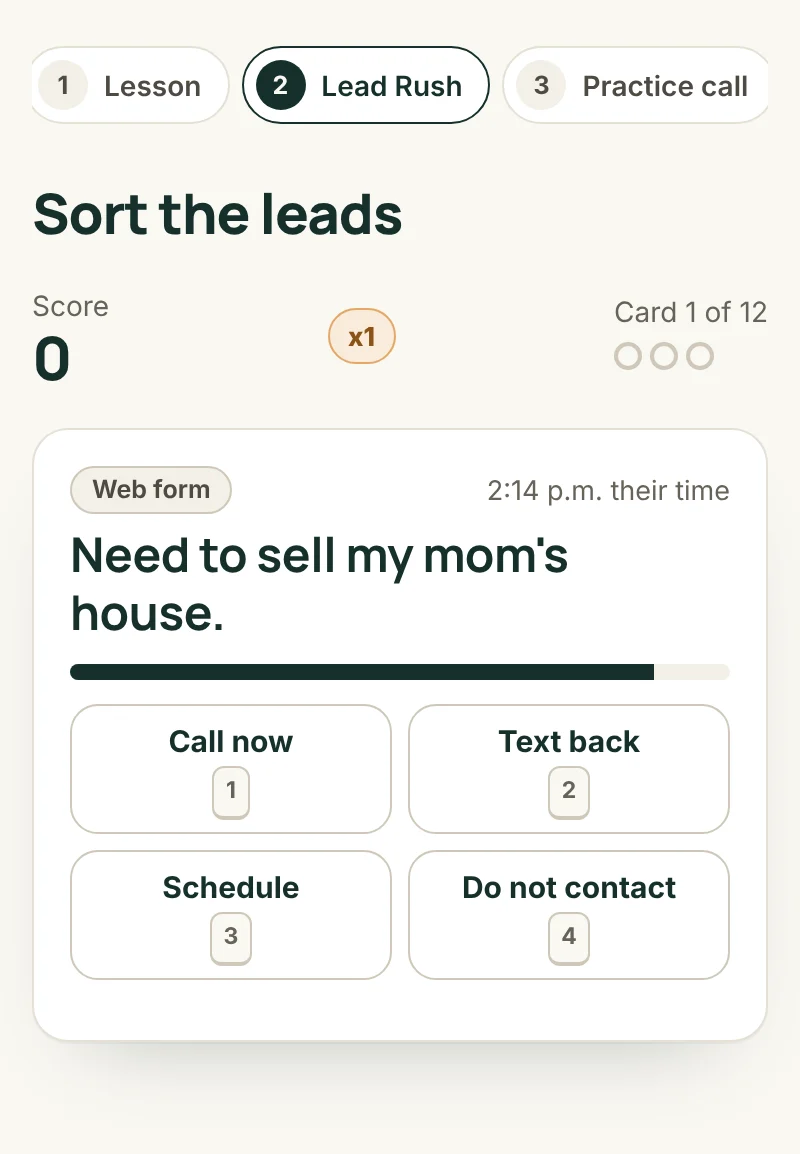
16 cards land on the desk, one at a time, and each one needs a decision before the fuse runs out. A lead manager sorts leads in Lead Rush, a dispositions rep sorts buyers in Buyer Sort and a project manager sorts bids in Bid Sort. Fast right answers score more.
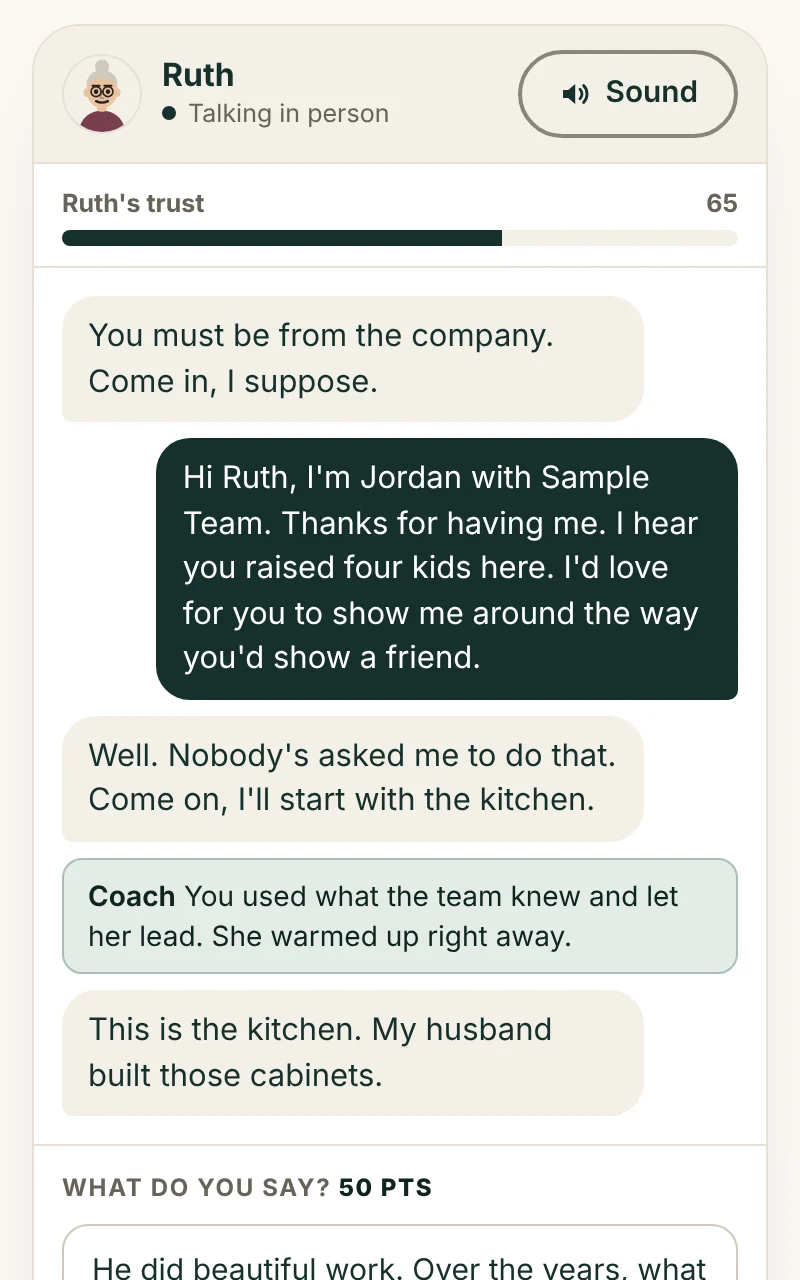
A call, a visit or a talk with a made-up person. The rep picks what to say. The other person answers in character, the trust meter moves, and a coach note explains why the line helped or hurt. A rough line can be rewound and tried again, at a cost in points.
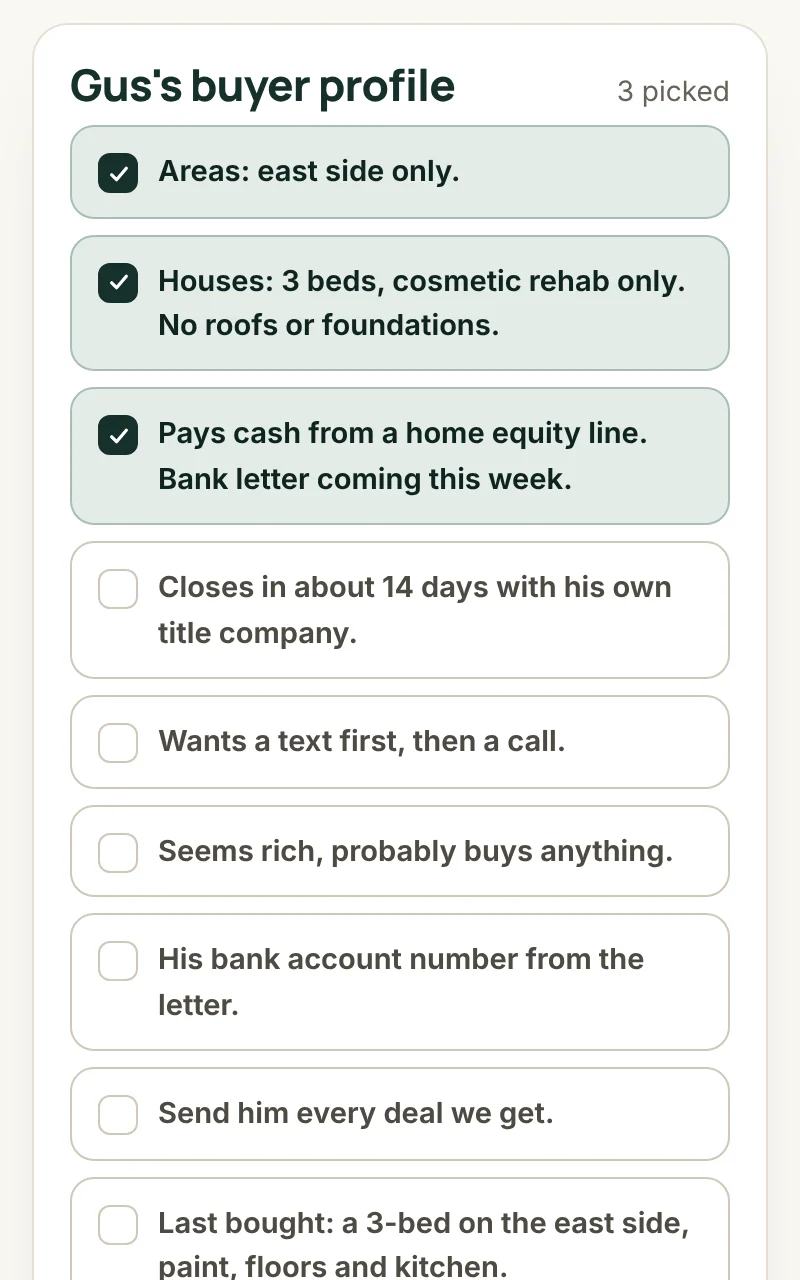
The rep puts together a piece of the job's own work, such as a buyer profile, a visit checklist or a deal sheet, by choosing the notes that belong in it and leaving out the rest.
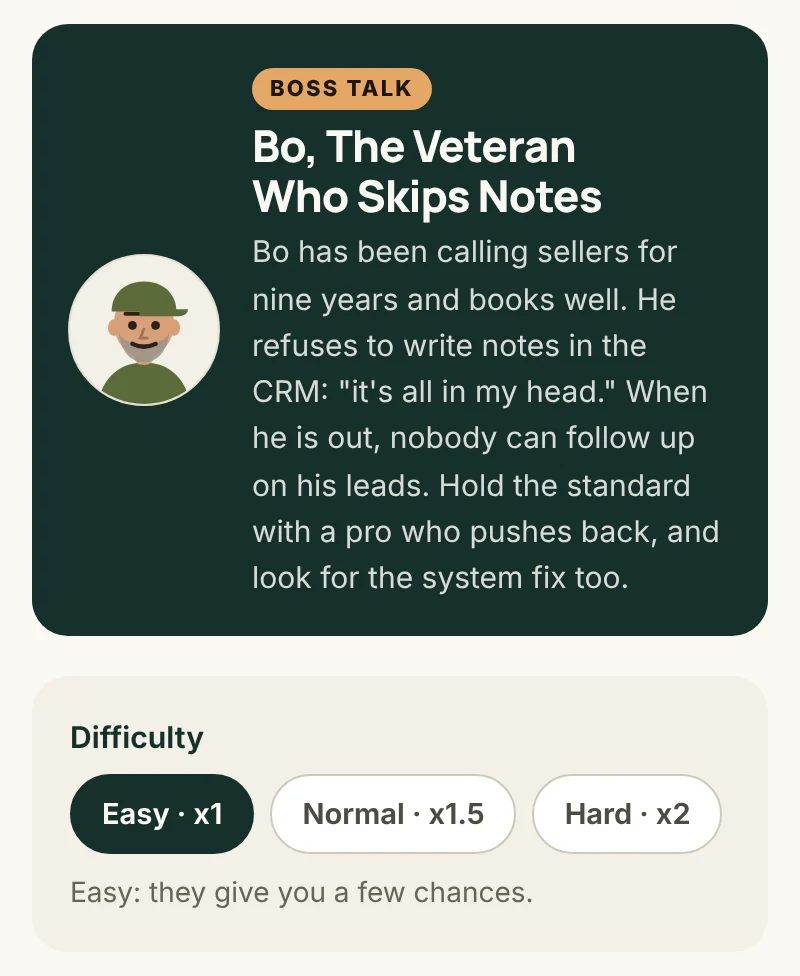
The hardest person in the level. A lead manager gets a boss call, an acquisitions rep a boss visit, a team lead a boss talk and a deal analyst a boss review. The rep picks easy, normal or hard. To pass, the round has to reach its goal before the other person's trust runs out. On some levels the rep can also face an AI seller and talk in their own words.
Twelve quick questions on what the level taught. Seven right answers pass it, and a rep who misses can go again.
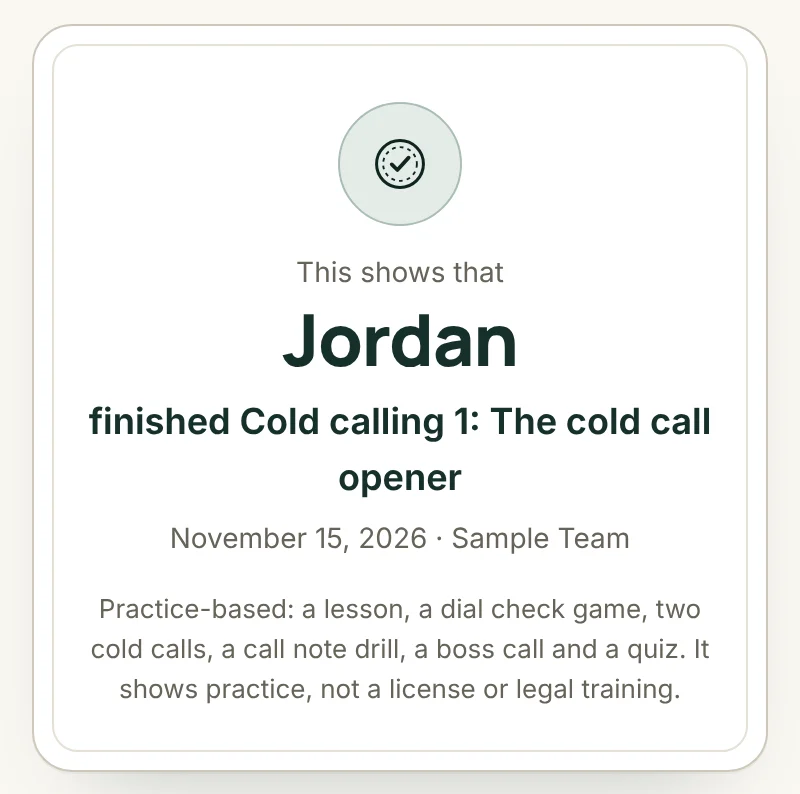
The rep gets a certificate with their name, the level and a check link. Anyone who has the link can confirm it is real, and the next level opens.
No sign-up. A free account saves progress from the second level on.
AI practice calls
On the lead manager path, four boss calls can also be played as an AI call. The rep types or speaks in their own words, and an AI seller answers in character. These calls sit on top of the levels. A rep can finish every level without one.
The seller stays in character for up to 12 turns. The call can end in a visit, a follow-up, a polite no or a hang-up.
A grade and notes on the seven things a call with a seller is judged on: opening, motivation, timeline, condition, price, listening, next step.
Hard sellers for reps who have finished their levels. A new seller joins on the 1st of every month.
Before a call that matters, the rep writes what they know about the lead and an AI seller plays that person.
Each plan gives every rep a number of AI calls a month, counted in one team total. Each plan lists how many it includes. AI sellers can say something odd now and then. They are practice partners, and no level depends on them.
Keeping score
A good line raises trust and a costly line drops it. When trust runs out, the other person ends the round. Harder settings start with less trust and punish a pushy line more, and they pay more points.
| Setting | Trust at the start | A good line | A close line | A costly line | Points |
|---|---|---|---|---|---|
| Easy | 55 | +15 | −5 | −15 | x1 |
| Normal | 50 | +15 | −8 | −25 | x1.5 |
| Hard | 40 | +12 | −12 | −45 | x2 |
A round ends early when trust falls to 10. With no good line in between, that takes three costly lines on easy, two costly lines on normal and one costly line on hard.
A practice round does not just pass or fail. It ends the way the real thing ends, and the result goes on the rep table for the team lead.
A rep who wants more pressure can switch on a clock: 12 seconds for each line, for more points. A line that times out counts against a clean round.
When you add people
Each job on a home-buying team has its own path of short levels, with made-up sellers, buyers and contractors who react to what the rep says. A new hire gets ready without a real seller on the line, and team leads get two 15-minute huddles a week already planned.
Play three turns of its first practice round. The person is made up and reacts to what you say.Each one opens the page for its path.
For the person who answers new seller leads and books the visit.
See the lead manager pathFor the closer who walks the house and makes the offer.
See the acquisitions pathFor the person who sells the team's deals to cash buyers.
See the dispositions pathFor the person who works the leads that are not ready yet.
See the follow-up pathFor callers and calling VAs who reach property owners first.
See the cold calling pathFor the person who takes a signed deal to closing.
See the coordinator pathFor the person who runs the reps day to day.
See the team lead pathFor the person who runs the numbers on each house.
See the deal analyst pathFor the person who runs the rehab on a flip or a rental.
See the project manager pathFor the person who brings in seller leads with mail, ads and other channels.
See the marketing pathFor the person who keeps the CRM and the team's systems clean.
See the operations pathFor the person who runs the houses the team keeps as rentals.
See the rentals pathReal-work practice
Short screens that put a rep in the real job, inside the app.
Who is this, what would you pay, STOP. Type each reply on a phone-style thread. Read by plain rules, no AI.
One seller, 60 days and six touches, played in about 6 minutes. A competitor shows up on day 35.
Two people, one phone. One plays the seller from a card with hidden facts and ticks what the rep found.
For team leads: pick the one thing to coach and give the feedback to a rep who pushes back.
After the levels
Skills fade when they are not used. A finished path leaves a rep with these.
One moment from the rep's own job every day. The rep picks an answer, then puts it in their own words. It takes about 3 minutes.
See the daily drillOnce a month, one boss round on hard for each finished path. The level changes every month, so the whole path stays fresh.
How the round worksThe lines that worked in practice, sorted by skill. A rep reads them before a shift or prints them for the desk.
See the playbook15 small forms, checklists and calculators for the deal on the desk. They are free on every plan.
See the job toolsWhat the team sees
Everything a rep does in practice lands on the rep table: levels passed, practice results, last active day and weakest skill. The Ramp Report turns that into a status and a next step for each rep.

Getting started
Pick a job and play its first level with no sign-up. It is the fastest way to judge whether your team would use this.
Sign in with Google, LinkedIn or a 6-digit code sent to your email. There is no password to remember.
Name the team and send one link to your reps. It takes about 2 minutes.
15 minutes with the cards your team missed most. The app plans it for you.
Free job tools
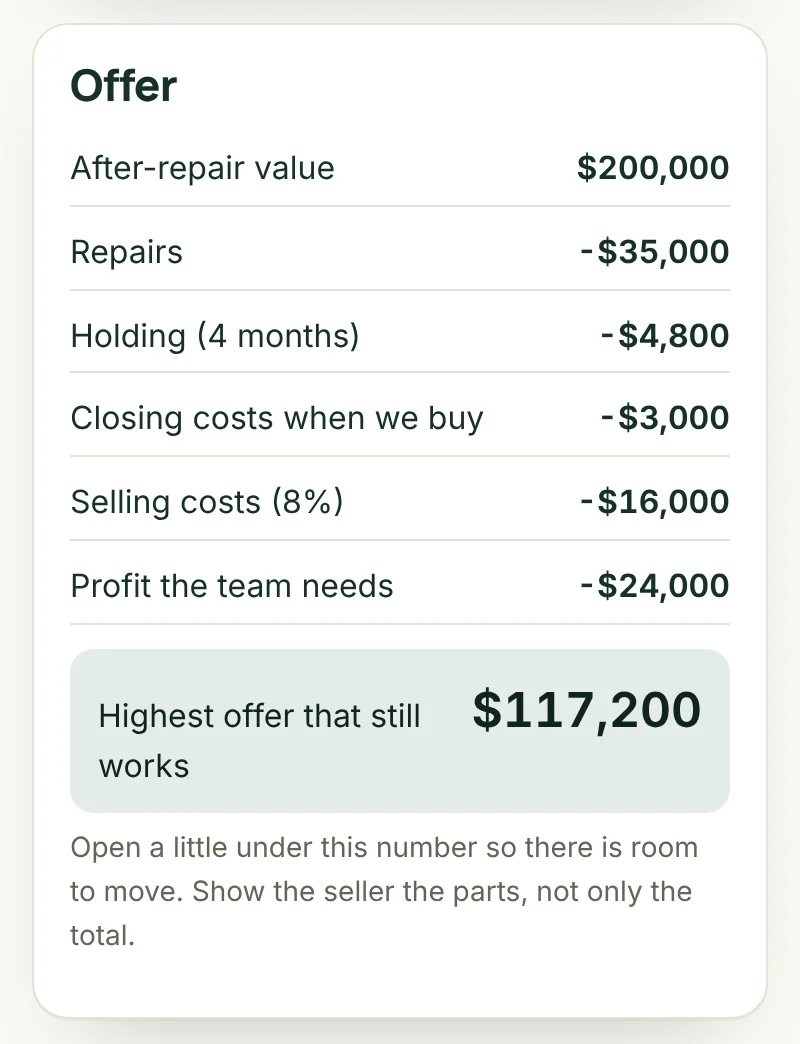
Climbmark also has 15 small tools for the work itself, from the offer and the follow-up to the buyers list, the closing and the rehab. A rep types in a real house, a real lead or a real bid and gets back something to use that day.
A level is short. A rep can stop after any round and carry on later from the same place.
No. Practice happens on the screen: the rep reads what the other person says and picks a reply. Sound effects and voices are optional.
Yes, on three of the paths: lead manager, acquisitions and dispositions. The rep reads the key points of a level and takes its boss round. A boss round that reaches its goal skips that level. A missed one shows which lines cost it, and the rep starts there.
Practice carries on with a 3-minute drill every day, a keep-sharp round once a month for each finished path, a playbook of the lines that worked and 15 job tools for the work itself. A skill that has not been used for 30 days comes back as a short check, and the team board starts a new season every month. See what stays after the levels.
No. Every person, team and number in the levels is made up, and nothing in the app calls or texts a real person. When a rep rehearses a real lead, they describe it in a few lines and the AI seller plays it under a made-up name.
As soon as you connect your CRM. The first look back at your last 13 weeks shows you one finding first. On the practice side, the rep table fills in as soon as one rep has played a level, and nobody has to type anything in.
Twelve jobs have their own path of levels: lead manager, acquisitions rep, dispo rep, follow-up specialist, cold caller, transaction coordinator, team lead, deal analyst, project manager, marketing manager, operations and crm admin and rental manager. A person who holds two seats can take both paths. See the job paths.
The team board compares the last 4 weeks with the 4 before: how many reps practiced, their practice minutes and rounds, and the average grade. A rep who has not practiced for 14 days, or whose grades fall a full letter, shows up in an alert with the skill they miss most. See the monthly cards.
No. On three of the paths, an experienced rep can skip a level by passing its boss round. The later levels of a path cover the harder parts of that job.
Yes. A team lead can share the team link, assign practice, run the huddles and review the rounds reps send in. The Ramp Report is written for you, and you can open it yourself or have it printed.
Remove them from the team and give the seat to someone else. Moving a seat costs nothing, and their history stays with the team. A seat can change hands up to 2 times a month.
Yes. Reps see only their own progress. Team leads and the business owner see results for their own team, after a second sign-in step. Read about security and privacy.
Climbmark reads the CRM your team already uses. Practice comes with every plan.